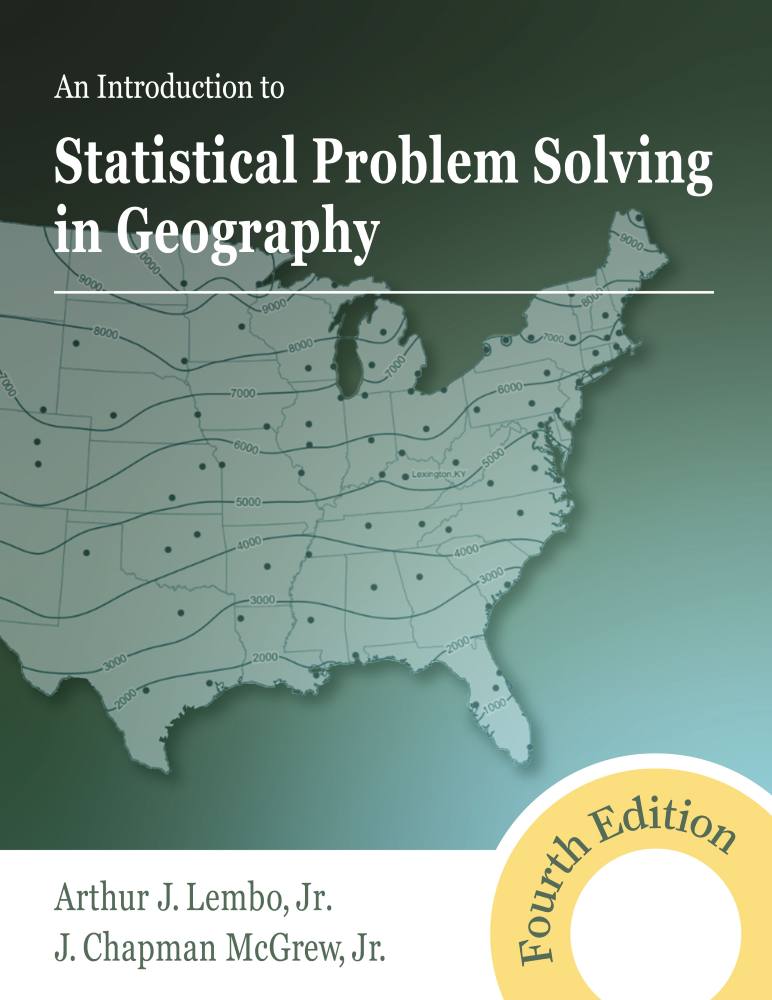
Description
This edition introduces more advanced topics, including logistic regression, two-factor ANOVA, and spatial estimation (inverse distance weighting, Kriging). Many chapters also include thought-provoking discussions of statistical concepts as they relate to the COVID-19 pandemic. Maintaining an exploratory and investigative approach throughout, the authors provide readers with real-world geographic issues and more than 50 map examples. Concepts are explained clearly and narratively without oversimplification. Each chapter concludes with a list of major goals and objectives. An epilogue offers over 150 open-ended geographic situations, inviting students to apply their new statistical skills to solve problems currently affecting our world.
“The reasonable cost is just icing on the cake of its other qualities. It is written at just the right level for undergraduate geography majors. The data examples are excellent. Every geography student finds some dataset that connects with their interests. The graphics are well drawn and produced.” -Charles Geiger, Millersville University
1. Introduction: The Context of Statistical Techniques
2. Geographic Data: Characteristics and Preparation
Part 2: DESCRIPTIVE PROBLEM SOLVING IN GEOGRAPHY
3. Descriptive Statistics and Graphics
4. Descriptive Spatial Statistics
Part 3: THE TRANSITION TO INFERENTIAL PROBLEM SOLVING
5. Basics of Probability and Discrete Probability Distributions
6. Continuous Probability Distributions and Probability Mapping
7. Basic Elements of Sampling
8. Estimation in Sampling
Part 4: INFERENTIAL PROBLEM SOLVING IN GEOGRAPHY
9. Elements of Inferential Statistics
10. Two-Sample and Dependent-Sample (Matched-Pairs) Difference Tests
11. Three-or-More-Sample Difference Tests: Analysis of Variance Methods
12. Categorical Difference Tests
Part 5: INFERENTIAL SPATIAL STATISTICS
13. General Issues in Inferential Spatial Statistics
14. Point Pattern Analysis
15. Area Pattern Analysis
Part 6: STATISTICAL RELATIONSHIPS BETWEEN VARIABLES
16. Correlation
17. Simple Linear Regression
Part 7: MULTIVARIATE PROBLEM-SOLVING IN GEOGRAPHY
18. Examples of Multivariate Problem-Solving in Geography
19. Multifactor Analysis: Two-Way Analysis of Variance
20. The Basics of Binary Logistic Regression
21. Estimation with Spatial Data
Part 8: EPILOGUE
22. Problem Solving and Policy Determination in Practical Geographic Situations
Appendix: Statistical Tables



Reviews
There are no reviews yet.