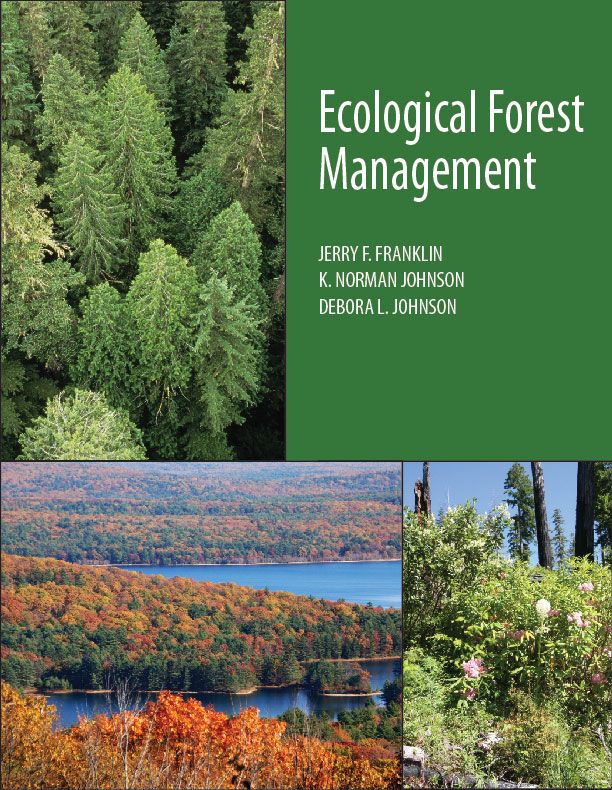
Description
“Regardless of where on the spectrum of forest management philosophy and practice you may fall, Ecological Forest Management is a thought-provoking and positively stimulating read, and is, in my view, well worth the price.” — Steve Wilent, Forestry Source
“Spectacular text!” — Kerry Farris, Oregon Tech
“The forests of the world will be better off for the publication and utilization of Ecological Forest Management.” — Andy Kerr, Public Lands Blog
“The textbook is an excellent resource, laying out the purpose and need for ecological forestry and providing up-to-date guidance how it can be achieved in the real world. It’s easy to read and illustrated with many excellent images and figures.” — Yvette Dickinson, Michigan Technological University
“This book is terrific! The layout is easy to read and understand and the content is comprehensive. I use it in my course on old-growth forest ecology and management and students seem to love it.” — Brian Harvey, University of Washington
“It’s an impressive book that I hope will enjoy wide use to train twenty-first century forestry students and influence the work of practitioners.” — Paul K. Barten, University of Massachusetts, Amherst
Table of Contents
Five Major Themes / An Ecological Approach to Forest Management / The Contributions of Expanded Scientific Knowledge / The Public Policy Framework for Forest Management / Negotiation: An Essential Element of Forest Management Planning / Change and Uncertainty: An Enduring Constant in Forest Management / Coping Mechanisms: Mysteries, Wickedness, and Tenets
Part I: ECOLOGICAL FOUNDATIONS
2. Understanding Forests as Ecosystems
Part 1: Attributes of Forest Ecosystems / Part 2: Forest Ecosystem Development
3. Forest Dynamics: Disturbances, Developmental Stages, and Forest Archetypes
Part 1: Disturbances and Biological Legacies / Part 2: Forest Developmental Stages / Part 3: Important Natural Forest Archetypes / Part 4: Disruptions Associated with Climate Change and Invasive Organisms / Conclusions
4. Silvicultural Principles for Ecological Forestry
Goals and Categories of Silvicultural Activities in Ecological Forestry / Principles Underlying Silvicultural Activities in Ecological Forestry / Developing Silvicultural Prescriptions in Ecological Forestry / Exemplary Applications of Ecological Forestry Principles
5. Larger Spatial-Scale Concerns: Landscapes and Regions
Part 1: Some Basic Concepts and Principles of Landscape Ecology / Part 2: Areas of Special Environmental or Cultural Significance / Part 3: Planning Management Activities at the Landscape Level
Part II: ECONOMIC AND SOCIAL CONTEXT
6. Economic, Social, and Political Drivers of Forestry
Ownership / Markets / Investment and Income Strategies / Policy Formation Processes / Social Acceptability of Forest Practices
7. Legal Frameworks for Forestry
Historical Development and Partial Review of Global Forest Policies / Legal Context for Management of Temperate Forests around the World / Key Federal Environmental Laws in the United States / The National Environmental Policy Act / The Endangered Species Act / The Clean Water Act / Implications of US Federal Environmental Laws for Ecological Forestry
8. Resolving Forestry Conflicts through Collaboration
Negotiation: An Essential Element of Modern Forest Management / The Many Forms of Collaboration / Collaboration: A Mutual Gains Approach / Effective Collaboration: Lessons from Two Decades of Experience / Successful Conflict Management and Dispute Resolution as a Forest Manager / Some Concluding Thoughts
9. Capital, Income, and Sustainability
Classical Investment Analysis: A Primer / Fitting Financial Considerations into the Multiple Goals of Many Landowners / Capital, Sustainability, and Intergenerational Equity / Appendix I: Additional Approaches to Financial Analysis / Appendix II: A Decision Tree for Choosing Present or Future Value Equations
10. The Economic Value of Forests
The Many Values of Forests / Appraisal / Hedonic Pricing / Contingent Valuation / Discrete Choice Experiments / Benefit Transfer / Deliberative Monetary Valuation / Summary / Appendix I: Vignettes to Illustrate the Application of Appraisal Principles / Appendix II: Zena Forest Appraisal and Conservation Easement
11. Adaptive Management: Achieving Resilience in the Face of Change and Uncertainty
Understanding Transformations in Natural and Human Systems / Adaptive Management / Monitoring: Developing the Information Base for Adaptive Management / Collaborative Learning, Multiparty Monitoring, and Adaptive Management / Continuing Development of the Scientific Base
Part III: CURRENT ISSUES IN FOREST MANAGEMENT
12. Forests on Fire: Nature’s Thermal Creativity (Christopher J. Dunn)
Introduction / Part 1: Fundamentals of Fire Behavior / Part 2: Fire’s Effect on Forest Communities / Part 3: Fire Regimes: Characteristics and Use / Part 4: A Wildfire Policy Based on Suppression: Origins and Effects / Part 5: Fire History as a Guide to Ecological Forest Management / Conclusions / Appendix: Fuel Models
13. The Fire Next Time: Strategies for Fire and Fuels Management (Christopher J. Dunn and Matthew P. Thompson)
Fire Management Options: An Overview / Understanding Fuel Treatments / Fuel Treatment Planning / Integrating Fuel Treatments into Forest Restoration / Leveraging Wildfires for Resource Benefits / Ecosystem Resiliency as an Overarching Goal / The WUI Problem: Fire Management’s Greatest Challenge? / Strategic Zoning for Wildlife Response: An Integrative Approach / Appendix: A Brief Discussion of Fire Models
14. Conserving and Restoring Biological Diversity (Cristina Eisenberg)
The Nature and Importance of Biological Diversity / Sustaining Forest Biodiversity / Species of Special Ecological Importance and Interest / The Formative Role of Law in Conserving Biodiversity in the United States / Combining Ecosystem and Species Approaches to Conserving Biodiversity / Conclusions
15. Climate Change, Carbon, and Forests
Part 1: Human-caused Greenhouse Gas Emissions and Their Role in Climate Change / Part 2: The Role of Forests in the Carbon Cycle / Part 3: Carbon Accounting in Forest Management / Part 4: Forests, Forestry, and Carbon Storage / Part 5: Forest Policies to Help Lower CO2 in the Atmosphere / Conclusions / Appendix: Forest Carbon Offsets in a Cap and Trade Program
16. Forest Certification
Emergence of Forest Certification on the International Scene / The Certification Process / Government Regulation and Forest Ownership Certification: Similarities and Differences / Two Views of Forest Ownership Certification / Comparison of Certification Systems / Potential Forest Certification Costs / Potential Forest Certification Benefits / Summary of Forest Certification Potential Costs and Benefits / Emerging Issues and Trends in Forest Certification / Certification and Ecological Forestry
Part IV: FOREST PLANNING
17. Classical Forest Regulation: Its Relevance to Ecological Forestry
Forestry’s Classical Decision Rules / The Regulated Forest / Achieving a Fully Regulated Forest / Relevance to Ecological Forestry / A Place for Classical Approaches in Ecological Forestry / Limits of Classical Approaches under Ecological Forestry / Conclusions
18. Making Decisions: Naturalistic and Structured Approaches
Naturalistic Decision-Making Approaches / A Role for Systematic Decision Making / Structured Decision Making for Ecological Forest Management / Structured Decision Making for Ecological Forestry: An Example / Forest Planning Models: Help or Hindrance? / Integrating Naturalistic and Structured Decision Making / Appendix: Developing Efficient Alternatives with Linear Programming
19. Forest Planning under Ecological Forestry
Forest Planning: The Pine Hill Forest Example / Linking Forest Planning to Implementation: The Importance of Spatial Analysis / Modeling Dynamic Spatial Objectives in Forestry / Appendix
20. The Greatest Good: Planning the Future of US National Forests
History / The National Forest Management Act / National Forest Planning under the NFMA / National Forest Planning in the 21st Century / Revision of the NFMA Planning Rule / A Role for Ecological Forest Management in Future National Forest Planning / A Role for Ecological Forest Management on Other Federal Forests
Part V: SUMMARY AND CONCLUSIONS
21. Potential Contributions of Ecological Forest Management
Overall Goals and Philosophy of Ecological Forest Management (EFM) / Contributions of EFM to Major Issues / A Policy Framework for EFM / Increasing the Adoption of EFM Globally / Conclusion


Reviews
There are no reviews yet.